Monday, September 30, 2019

tallow


We live quite a sustainable DIY life here on the farm.  There is always a project or two (or three) going...

I am now utterly convinced of the health benefits of Lard (pig fat)and has been using this in place of vegetable cooking oil for more than a year.


I received an order to make tallow (beef fat) for a very talented young woman that sells eco-friendly products and she wanted to experiment with tallow in her soap- and candle making projects. Olivia from Ecoconscious fiji is truely inspirational in her quest to live eco friendly.

Tallow is an alternative animal fat , similar to Lard which is made from pig fat.  It should be from grass fed animals.   It was the fat of choice for our grandparents before industrial seed oils (which is extremely inflammatory and bad for the heart) took over the market.  Basically, you make tallow by rendering beef fat. Rendering just means that the beef fat is heated and melted. Tallow is what the beef fat turns into when it is melted. Once it is cool again, tallow is solid at room temperature.

Tallow is made from rendering suet, which is the hard, white fatty layer that surrounds an animal's organs, specifically the loins and kidneys, also known as leaf fat. It takes hours of boiling over a slow heat but the end product is totally worth it.


It has a high smoke point and adds a lovely flavour to fried foods. Eating healthy animal fats like tallow, duck fat, butter, etc. along with foods helps us to absorb and assimilate the vitamins in those foods. For example, eating vegetables that have been fried in tallow or have melted butter on them allows our bodies to better absorb and use the vitamins in the vegetables and it tastes beyond yummy!

It is rich in CLA (conjugated linoleic acid), a fatty acid that can help burn fat that is high in minerals.

It is high in saturated fat, absorbing fat soluble vitamins A,B12, D, E and K which supports the immune system.

It is Keto friendly and an alternative to butter, lard, coconut oil or olive oil. (healthy fats)

Used in DIY home remedies and products , being the original "body butter" full of fatty acids that are the building blocks of skin cells.  Tallow is good outside and inside!

Used in soapmaking

Used in candlemaking

My tallow is sourced from grass-fed animals and I am proud to be making and selling it. 


Friday, February 22, 2019

Being conned to accept factory food...


LARD :

~ high in vit D
~ 60% monounsaturated fat
~ perfect for baking, pies & pastries
~ connects you to a local farm
~ economical
~ has a high smoke point (190deg)
~ odourless, tasteless
~ contains no chemicals, only time & effort 


The story of Crisco begins innocently enough in pre-Civil-War America when candle maker William Proctor and his brother-in-law, soap-maker James Gamble, joined forces to compete with fourteen other soap and candle makers in Cincinnati, Ohio. P&G entered the shortening business out of necessity. In the 1890s, the meat packing monopoly controlled the price of lard and tallow needed to make candles and soap.1 P&G took steps to gain control of the cottonseed oil business from farm to factory. By 1905, they owned eight cottonseed mills in Mississippi. In 1907, with the help of German chemist E. C. Kayser, P&G developed the science of hydrogenation. By adding hydrogen atoms to the fatty acid chain, this revolutionary industrial process transformed liquid cottonseed oil into a solid that resembled lard.1
Not content with using hardened cottonseed oil for soaps, and mindful that electrification was forcing the candle business into decline, P&G looked for other markets for their new product. Since hydrogenated cottonseed oil resembled lard, why not sell it as a food?
The new product was initially named Krispo, but trademark complications forced P&G to look for another name. They next try was Cryst which was abandoned when someone in management noted a religious connotation. Eventually they chose the near-acronym Crisco, which can be derived from CRYStalized Cottonseed Oil.
Crisco was introduced to the public in 1911. It was an era when wives stayed home and cooked with plenty of butter and lard. The challenge for Crisco was to convince the stay-at-home housewife about the merits of this imitation food. P&G’s first ad campaign introduced the all-vegetable shortening as “a healthier alternative to cooking with animal fats. . . and more economical than butter.” With one sentence, P&G had taken on its two closest competitors—lard and butter.
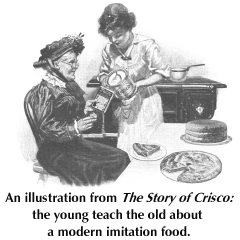
P&G’s next step was a stroke of genius—they published and gave away a cookbook. The Story of Crisco2 looked like most other cookbooks of the era, but there was a difference. All of its 615 recipes, everything from lobster bisque to pound cake, contained—you guessed it—Crisco.
crisco_image.gif
The Story of Crisco is recognized as a classic in the subtle art of persuasion. Its language and contextual variety are “representative of the pre-WWI social milieu and reflect the urbanization, domestication, commercialization, education (or lack thereof) and simple sophistication of the times.”3 Crisco is presented as healthier, more digestible, cleaner, more economical, more enlightened and more modern than lard. Women who use Crisco are portrayed as good wives and mothers, their houses are free of strong cooking odors and their children grow up with good characters (because, according to the tortured logic of P&G’s advertising department, Crisco is easier to digest).
P&G also had the brilliant idea of presenting Crisco to the Jewish housewife as a kosher food, one that behaved like butter but could be used with meats. Because it made kosher cooking easier, Jews adopted Crisco and margarine—imitation lard and imitation butter—more quickly than other groups, with unforeseen consequences.


Www.westonaprice.org

We also didn’t know that the partially hydrogenated oils in Crisco—the trans fatty acids—were bad for us. In fairness to P&G, they didn’t know this either, not at first. But when reports of problems began to appear—problems like increased heart disease, increased cancer, growth problems, learning disorders and infertility—P&G worked behind the scenes to cover them up.4 One scientist who worked for P&G, Dr. Fred Mattson, can be credited with presenting the US government’s inconclusive Lipid Research Clinics Trials to the public as proof that animal fats caused heart disease. He was also one of the baleful influences that persuaded the American Heart Association to preach the phony gospel of the Lipid Hypothesis.
The truth about the dangers of trans fatty acids in foods like Crisco is finally emerging. Perhaps that is why P&G decided to put their flagship product up for sale.


Eliminate two things—hydrogenated fats and high fructose corn syrup—and you will see noticeable health improvements. Not all hydrogenated fats are made with cottonseed oil today; in fact, most are now made with soybean oil. But by eliminating just these two commodities—which is not as easy as it sounds—you will find that you have eliminated the majority of the “displacing foods of modern commerce” that Weston A. Price spoke about.

Tuesday, January 30, 2018

rainy days...

Weather man has predicted rain...lots of it...which we need 
but it is also cyclone time and a cyclone could be lurking in those red blotches (clearly visible in the radar map below) and make our lives miserable....  

My cucumber patch is  bursting with fruit at the moment....and a cyclone or prolonged period of rain would destroy the fruits.... 


Mr Google suggested pickling the cucumbers.....

so out in the rain I went and got some for me...
                                                some for the chooks 
                                             and some for the goats.....


I estimated the amount of jars needed and started to sterilize the jars....any excuse to cook on the fire...as you know by now... I Love My Fire.  


Sliced not too thick.....


layering the jars.  I used curry leaves as the dill in my garden was too young. I also used chili from the garden , pepper corns and cloves. 


 Curry leaves are the leaves of the curry tree, scientifically known as Murraya koenigii Spreng . The plant is native to India and is usually found in tropical and subtropical regions and grows profusely on our farm. 


The pickling fluid was a cup of water to half a cup of vinegar with 1 tablespoon of salt.


I think the pickled cucumber came out quite nice..... 


The kefir is also going well....feeding the grains every day!  


after a quick lunch I can now retire.... and spend the rest of the rainy day in cyberspace  ....


 Hoping for rain,
                          no flooding , 
                                           no damage and
                                                                   definately no cyclones.....


have a good day!


Sunday, December 3, 2017

so the casava was a failure....

casava did not survive the drought...
                                                                   or the cows...
                                                                                       and finally the horses....


  such a sad sight...not even thinking of the hard work...sweat...in the sun.....all the   work that proceeded this....
(way back in January/February  planting new field )


worst of all is the fact that the cows and horses that invaded the field during the drought did not belong to us....


but claude got stuck into the field this morning....


(just two nice shots from the cabins.....)


and viola!  it is a neat and tidy little field again.....


new little coconut palm trees  growing happily  ....waiting to be planted in the clean field......


Thursday, November 30, 2017

in the search for Roza...my horse

My search for Roza, the stallion that got stolen from our farm end July, lead me to the island of Waya.  Information gathered suggested that two horses were uploaded on a barge about 3 weeks ago and taken to this island...  Our local Police  Department were involved after the information gathering and when it was confirmed that a dark brown horse and lighter horse were indeed taken to the island, the Police took over...


Getting to the island turned into an adventure...

Because I am not police, I had to make my own way there.  I used the cargo boat from the resort and made my way to the island.  Fortunately it was a smooth ride....


It turned out to be an unsuccessful mission....I was sooo bummed!


 This farmer farms on the slopes of the island....hard life! 


I was sooo convinced it was my horses!


The police was absolutely great.  They helped and followed up, most were completely out of their comfort zones.   It is not everyday that their jobs entails searching for horses on remote islands....using open, long boats.....


But there was a good side as well.  We visited one of the most beautiful islands of Fiji, Waya.  Ways actually has 3 islands in close proximity - Waya, Wayaseva(small waya) and Kuata.  There are resorts on all of them. 

 Kuata resort is a backbackers when glamp tents - dorms and more luxurious tents and camps.  I loved my stay there.
This is a view of the tented dorm that I stayed in. 


 a view of Wayaseva,  the second largest island in this group of 3 islands.


so, although my horse is still gone....


I got to meet lovely people and spent a very enjoyable time ...

horse rescue


So, the drama with SPeedy, one of our horses started early one morning.  Because it is so dry, rains are late this year... I have kept Speedy untied.  He is older now and we did not want him to loose condition...so he is free to roam....
Well, he followed some other horses home one night and did not come home....I searched until dark and continued the next morning....

O boy, was I shocked to find him stuck in the mud - right up to his neck!  and Murphys law -  yes, the skies were dark blue with rain looming.


The hole was not easy to reach for a digger , and our good friends Pierre Guyot and his son Rupe were not very hopeful....


 Pierre started to dig , but before he could reach the mud he had to make a ramp of sorts....


It took hours.  But eventually we managed to free a very weak horse from the mud.


 Speedy was ravenous and just wanted to eat. I hosed him down and took a looong shower myself.


The next morning he was very sheepish but recovered well despite his ordeal.


 and my horse is still gone.  The stallion got stolen end July and there is not a week that goes by that we don't actively look for him....one of these searches took me to a beautiful island, Waya, but more about that in another blog post....